
by Ty Hulse

As the industrial revolution wore on, the smog grew so thick that moths’ wings turned black, and the London rivers began to smell so foul that the newspaper “City Press” stated; “it stinks, and whoso once inhales the stink can never forget it and can count himself lucky if he lives to remember it.” Further, during this time society had become repressive and increasingly judgmental. People needed an escape from these repressive, stink filled, cities, and in the 18th and 19th centuries fairies became this escape. They were a nostalgia for an imagined and fading past of a joyous and rustic life. They were the beauty of the countryside. A rebellion against industrialism, despair, and repressive morality. It was this desire for something beautiful through fairies that prompted Charles Dickens to state that “In a utilitarian age, of all other times, it is a matter of grave importance that fairy tales should be respected."
People longed for a return to an imagined and romanticized past of magic and pastoral beauty. Many felt that this new polluted world was being ruled by bean counters who would work everyone to death and kill the world with filth in the process. Or as Edmund Burke observed: “The age of chivalry is gone. That of the sophisters, economists, and calculators, has succeeded; and the glory of Europe is extinguished forever.”
Fairies were, to the minds of many artists and philosophers a way to criticize and escape the modern world. We can see this push back against the ‘modern age’ of the 19th century represented in fairy paintings such as “The Nymphs and the Satyr” by William-Adolphe Bouguereau (1873), a painting which came at a time when moral panic had led people to decry the corruptions of Wall Street and the erosion of virtue caused by luxuries and diversions. People feared and attacked ideas of sexual expression during this time, and there was a clear difference between the ideals that were espoused in public and personal behavior. That is there was a public sphere where people exhibited self-control and a private sensual underworld that could only be explored by artists through the use of fairies and mythology.
People desired this more sensual and freer world so much that when the ‘Nymphs and the Satyr’ was hung in a New York bar this painting of nude nymphs being sexually playful with a satyr caused enough excitement and interest that women cued in long lines to see it, forcing the owner to ‘institute a weekly visiting day to accommodate their intrusion.”
_-_Nymphs_and_Satyr_(1873)_HQ.jpg)
The interest in the painting of ‘The Nymphs and the Satyr’ came from more than just a longing for the whimsy of the countryside, it expressed and contained transgressive female sexual power. The theme of dangerous eroticism would have been obvious to any Gilded Age viewer.” After all, Nymphe du Pave was a word for streetwalker, nymphomania and satyriasis were terms for sexual obsession. So people were well-aware what the nymphs and a satyr in the painting represented. Yet at the same time, despite their seeming sexual nature, the nymphs in the painting “don’t give themselves over to ecstatic adventure… rather they perform ecstasy and impulse for us. Their performance is itself a mode of transgressive power. It is not genuinely horrific and deadly, but it is not quite safe either.” (Sayre and Lowy) The nymphs represent freedom, something fairies and nymphs have often represented. In Ancient Greece itself “The nymph embodies the fantasy of total female independence.” She enjoyed the freedom that was denied to Greek women. Nymphs were most often represented in dance, for “only in dance could a Greek woman be the center of attention.” (Larson)
Sexual innuendo and violence have long been an important part of stories about fairies, fantasies, and comedy in general. We see similar ideas presented in some of the best animations from ‘the golden age’ with cartoons such as those by Tex Avery’s whose “animations were filled with sexual inuendo and near random violence, he brought people face to face with a world “of good, evil, and morality in a world deprived of its previous landmarks.” In some ways he can be seen as a master of grim humor in a much more slapstick way.” (Place-Verghnes, Floriane)
In a similar vein to Tex Avery cartoons, stories of the fairy Puck in the Early Modern played with taboos and morality in interesting ways. Even before Shakespeare, Puck was a common character in the stories that women shared at home. He did a number of ridiculous things that would often annoy women, such as putting dirty diapers back on babies. Yet interestingly he also taught people how to clean and would even help women with their work, and always carried a broom and a threshing flail. Perhaps more importantly, for our conversation, stories that involved him often played with sexual taboos and humor. Buccola stated that;
"Nothing pleases Puck more, Latham claims, than to make the morning fire, sweep the house, grind mustard and malt, draw water, and help the maids with breaking hemp, bolting and dressing flax, as well as spinning….
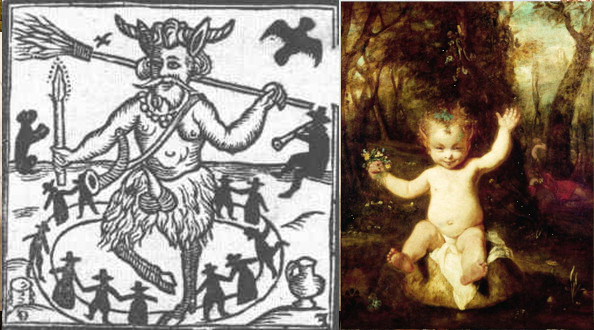 |
| (left) A woodcut of Puck from 1629, when he was a sexual yet strangely moralizing figure who taught people about housework but had a large penis. At this time fairies were largely ambiguous figures, being both maintainers of culture norms and yet often depicted as crude and irreverent figures of salacious comedy. (Right) Puck by Joshua Reynolds 1789. Overtime fairies began being depicted as more childish and whimsical, even if though many in the countryside still feared them. Robin Goodfellow was typically depicted with a huge phallus and a broom. It takes little present-day imagination to come up with reasons why early modern women might have sat around the fire over their darning sharing tales about a figure with such attributes - or why he was such a popular character in ballads and tales. |
Fairies have long been used to discuss things that couldn’t normally be discussed in polite society, just as seductive power has long been used to represent freedom, and even in modern Disney cartoons such as “Frozen” the Snow Queen Elsa transforms her dress into something slinky while doing a slightly provocative walk during her big musical number about freedom, representing her final step to independence and escapism. Psychologists have found that such representations can provide psychological gratification that does indeed allow people not only to escape reality, but to think more clearly about their own.
Part of what has allowed many fairytales to survive as long as they have is their ability to break certain taboos. For “Culture orders, labels, and segregates man's experiences, tabooing certain acts, substances, or creatures which might upset that order. Mankind's continuing attachment to disorder and to violation of boundaries is show not only by the pleasure in hearing tales about tricksters but also in primitive rituals which demonstrate an awareness of the powers of the disordered state… Useful as the taboo is for ordering life, 'the dramatic combination of opposites' is finally more satisfying." (Gose)
In art fairies are able to break taboos and criticize society because they are unreal. They represent desires and freedom, such as a nostalgia for a harmony between man and nature. People have often seen the countryside as perfect and believed in a wonderous golden age of the past. This sort of thinking wasn’t new to the 19th century. The ancient Greeks and Romans, and pretty much anyone else in cities had longed for the countryside. In ancient Rome Virgil and Horace “contrast the city – a place of commerce governed by ambition and greed, productive of insecurity – with the country, which always retains traces of an ancient era of perfect happiness.” (Lowy) The Roman poet Horace specifically called those living in the country a “pristine race of mortals” working their ancestral lands, happy men without the cares of business.”

While such musings might not be true, they are symbolically powerful. Obviously, nostalgia for the country as a land of perfect contentment is somewhat misplaced. Peasant farmers had incredibly difficult lives, but it is also true that people belong in a more natural environment so much so that psychologists have found that paintings of nature can increase happiness. Further the longing and dream of a pristine natural world led people to believe and seek for things – such as fairies. It was during this time of nostalgia and the search for beauty in the past, in magic, and in the countryside that “increasingly a softer, less threatening fairy crept into popular culture. The ballets of ‘La Sylphide’ by Marie Taglioni and the Shakespearean productions of A Midsummer Night’s Dream (1856) and The Tempest (1857) by Charles Kean in the 1850s brought fairy beauty to the Victorian stage… The interest in fairies as escapism can be traced back to the Romantic movements, and a reaction against the Enlightenment in the late eighteenth century.” (Bihet)
People began to dream of escaping the mundane world to a land of endless play and enchantment. So at first people of the era rarely trivialized the romantic idea of the playful and sweet fairyland because it was childish or whimsical but loved it because it was these things and realized that humans needed more of that in their lives. This largely cumulated in the fame of Peter Pan, a fictionalized child who never wants to or has to grow up, who lives in a land that is perfectly set up for children to play in with pirates and of course, fairies.
Much of this longing for the past meant that the romanticists and other artists had an almost reverence for medieval and Early Modern literatures such as Spencer and Shakespeare. Chivalric themes became ever more popular as did whimsical romantic plays that were so much about spectacle that one critic argued that they were nearly irrelevant. Yet audiences loved and flocked to these plays of spectacle and magic.
Part of what draws people seeking a more utopian world to fairytales is that this is one of the primary purposes these tales originally served. “There was a time when folk tales were part of communal property and told with original and fantastic insights by gifted storytellers who gave vent to the frustration of the common people and embodied their needs and wishes in folk narratives. Not only did the tales serve to unite the people of a community and help bridge a gap in their understanding of social problems… but their aura illuminated the possible fulfilment of Utopian longings and wishes which did not preclude social integration.” (Zipes – ‘Breaking the Magic Spell’)
Of course, as Bown points out in her book “Fairies in the 19th Century Art and Literature” there is a sad melancholy side to romanticizing the past, for it will never come again, and never existed the way we imagine it. This melancholy associated with fairyland and the past and a vanishing magic is illustrated by the poem by Tennyson ‘Bugle Song’ from “The Princess”
The splendour falls on castle walls
And snowy summits old in story:
The long light shakes across the lakes
And the wild cataract leaps in glory.
Blow, bugle, blow, set the wild echoes flying,
Blow, bugle; answer, echoes, dying, dying, dying.
O hark, O hear! how thin and clear,
And thinner, clearer, farther going!
O sweet and far from cliff and scar
The horns of Elfland faintly blowing!
Blow, let us hear the purple glens replying:
Blow, bugle; answer, echoes, dying, dying, dying.
O love, they die in yon rich sky,
They faint on hill or field or river:
Our echoes roll from soul to soul,
And grow forever and forever.
Blow, bugle, blow, set the wild echoes flying,
And answer, echoes, answer, dying, dying, dying.
Even as fairy poems, plays, and art grew ever more popular, these whimsical forms had their critics. The art critic T. G. Wainewright heard someone say of the painter Fuseli “I hate his fancies of fairies and spirits and nonsense. One can’t understand them… It’s foolish to paint things which nobody ever saw, for how is one to know if they’re ever right?” (Bown) What’s more, even the public who loved the fairies wasn’t necessarily willing to throw away social convention and the modern world for them, thus industrialism and Victorian moralism continued. It is important to remember than that fairies, fairytales and fantasies don’t represent what people will do, they represent dreams, fears, anxieties, and more.
Above all else, fantasy can represent a philosophical and emotional battle, between tradition and the new, the countryside and progressivism. The people behind the movement known as the Enlightenment sought to create a better world, to cast off the shadows of the past and prejudice while the Romanticists sought the past and its traditions, putting them in a more romantic light, as it were. The fairies came to represent the goals of the romanticists and their emotional and philosophical descendants.
As Michael C. Kotzin has pointed out in his book ‘Dickens and the Fairy Tale’’:
The cause for which the Romantics spoke came to have greater urgency as the conditions which provoked them to defend the fairy tale intensified during the Victorian period. Earnest, artless, middle-class Evangelicalism increased its influence; the education theories of the Enlightenment were succeeded by those of its even less imaginative descendant. Utilitarianism, and the age of the city, industrialism, and science came fully into being. These conditions of England were objected to by Carlyle and by such followers and admirers of his as Ruskin and Kingsley. In discussing the fairy tale these men followed the Romantics by stressing its imaginative value in the new world.”
What we see then is that there were artists and philosophers and folklorists who sought fairies not only as an escape from the modern world, but as inspiration to improve it. They saw fairies as whimsical and childlike, as creators of beauty, as representatives of nature, and as a way to a more magical and wonderous life. Francesca Bihet states that;
The public looked to fairies as representatives of the natural world, away from the smoky chimneys and cramped cities. Fairies are profuse throughout nineteenth-century theatre, literature and art. Fairy ballets such as Giselle, Le Lac des Feés, Sire Huon, Ondineí, and Eoline were performed across Europe. J. R. Planché’s Christmas ‘fairy extravaganzas’ enjoyed annual popularity between 1836-1856. Gilbert and Sullivan wrote an operetta ‘Iolanthe, or the Peer and the Peri’ (1882). Jason Harris argues that such ‘fanciful but distorted representations’ of ‘sentimentalized fairies’ found in popular culture had ‘effaced the folk roots’ as artists and writers ‘dazzled’ the public. The spectacular and escapist nature of these fairy presentations naturally lent themselves to the whimsy of children’s culture. After all, the fairy tale was increasingly considered appropriate children’s literature in the late nineteenth century.
This escapist idealism contrasts, at least in part with early 19th century philosophers such as Schopenhauer who believed that the state of the sublime, beyond beauty, was to be found in terrifying landscapes and pain with beauty. According to these artists, perfect escapism into nature happens when one sees something stunningly beautiful that is also so fearsome or vast that they “consciously turn away” and in so doing “violently wrenching himself free from his will.” This in turn leads to an elevated state, or the feeling of the sublime. Such ideas are useful in so far as fairies are concerned for, they were at once dangerous and helpful creatures. Many who encountered them reported being afraid, awed, and of course dazzled by them.





 Posts
Posts


