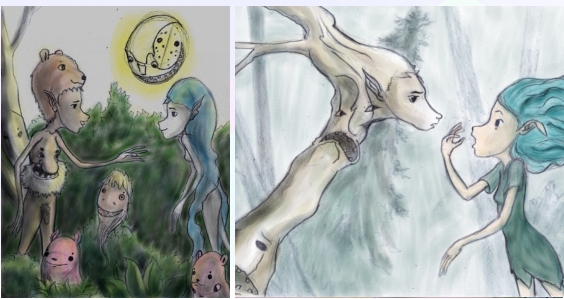
Wednesday, November 21, 2012

House Fairies

I am creating a comprehensive resource about fairies.

Article by Ty Hulse

House, Hearth, and Field

Long after humans had left the wilderness, they were still intimately intertwined with fairies. So intertwined in fact that humans built their farms and cities around the desires and actions of the fairy. Or perhaps it might be more accurate to say that humans learned farming, the arts, and how to build cities from the fairies and deities they prayed to for help in these endeavors. For fairies are not strictly creatures of the forests. They help humans with domestic choirs, medicinal tasks, the arts, and agriculture.  Certainly, some of these fairies provide this aid because they are ancestors of the people they are helping as is the case with banshees and domovoi. This is not the case with all fairies which help humans, however. Many appear to be as feral as any wilderness fairy and others which truly are wilderness fairies.

There is a castle in Scotland, for example, which was inhabited by selkies who provided advice and help to the castle’s inhabitants (Briggs, 1967) Many of the fairies which have become domesticated fairies appear to be those of other types which humans have asked to take on new roles. This is especially true of agricultural fairies which are most often clearly a form of nature fairy set to causing crops to grow. Of course, given that the crops themselves are natural plants which have been altered to fit human purposes, it should not be surprising that the fairies of these plants would be altered in addition. No one has made a better or more extensive study of agricultural fairies then the writer of “The Golden Bough” who points out that at one time people would say that the Grain-Mother, Goat, Wolf, or whatever other form the grain fairy took, was running when the wind blew through the fields thus personifying the field and all its actions.

The spirit of the grain was believed to live within the last bit of unharvested grain, and there were a number of rituals designed to keep in the grain fairies’ good graces. In some cases, the people would even turn the last of the grain into a doll in female form so that all the farmers could dance with it. “The Golden Bough” notes this repeatedly in one specific case it mentions that in parts of France the last sheaf would be named the Mother of the Wheat, Mother of the Barley, Mother of the Rye, or Mother of the Oats and would be made into a puppet dressed in clothing and given a crown and a blue or white scarf. In another case he notes that:

“A branch of a tree is stuck in the breast of the puppet which is now called Ceres. At the dance in the evening Ceres is set in the middle of the floor, and the reaper who reaped fastest dances around it with the prettiest girl for his partner. After the dance, a pyre is made. All the girls, each wearing a wreath, strip the puppet, pull it to pieces, and place it on the pyre along with the flowers with which it was adorned. Then the girl who was the first to finish reaping sets fire to the pile, and all pray that Ceres may give a fruitful year” (Frazer, 1922)

In this ritual then, we see a clear continuation of the belief that tree spirits help create a fruitful harvest. In parts of Dumbartonshire, the Maiden of the corn would be dressed in ribbons and hung in the kitchen for the entire year. In Bruck in Styria she would even be dedicated in the Christian Church indicating the longevity of the peoples’ respect for the fairies involved in the harvest, or at least in the tradition.  Here they also took the extra step of making the finest ears of grain into a wreath which were twined with flowers and carried on the head of the prettiest girl in the village. The Slavs also made a wreath from the last sheaf known as the Rye-mother, the Wheat-mother, the Oats-mother, the Barley-mother, and so on which would be placed on a girl’s head and kept until spring when it would be mixed with the seeds the farmers planted. Other people drench with water the last girl who cut the last sheaf of grain. The fertility of the fairy is considered to be so strong that it was believed that the person who cuts the last sheaf of wheat will be married within a year. (ibid)

It’s interesting to note in this last example there was believed to be a connection between the fertility of harvest spirits and the fertility of people. This is further illustrated by examples where it was believed that humans could pass on their own fertility to the fields.  In a number of parts of Europe, girls and boys would roll around in the fields together imitating the act of procreation in order to grant them their fertility. For example:

“In the Ukraine on St. George’s Day (the 23rd of April), the priest in his robes attended by his acolytes goes out to the fields of the village where the crops are beginning to show green above the ground and blesses them. After that, the young, married people lie down in couples on the sown fields and roll several times over on them in the belief that this will promote the growth of the crops. In some parts of Russia the priest himself is rolled by women over the sprouting crop.”

Other peoples pretended to be giving birth to the last sheaf of grain, wailing as if in labor. (ibid) What are we to take from this relationship between plant and human fertility? Certainly, it’s true that most early magic is based on sympathy; however, is this simply a case of humans giving grain fairies ideas? Of course, it’s also possible that this is a case of humans actually impacting the energy of the fields themselves, that there is an actual relation to the souls and fertility of humans and those of plants. This is not to say, however, that harvest fairies are always treated with the greatest of respect. In many cases they are treated in much the same way that forces of nature are treated. In some places, for example, people threaten to cut down a tree if it does not yield good fruit. In others, people mock the fairy, teasing it while it remains in the last sheaf of grain. Other people even try to drive the fairy away by beating the last bits of grain with sticks. The connection between humans and harvest fairies it would seem is not always guaranteed but varies from place to place.

Part of the reason humans may attack the grain fairy in some places is because the fairies of the grain are often dangerous which is also why parents tell their children to avoid going into the fields or the Grain-Mother will catch them. It is at this juncture that we begin to see the split from the fairies of the grain and humans. Indeed many lands have grain fairies that look like animals rather than people.  When the spirit is an animal, it is often considered more feral than that of a human, and it is more likely that people will need to either catch or kill it when it is in the last sheaf of grain. Further, such fairies will cause illness to those harvesters who stumble upon them.

As the corn is being cut, the animal flees before the reapers. If a reaper is taken ill on the field, he is supposed to have stumbled unwittingly on the corn-spirit who has thus punished the profane intruder. It is said, “the Rye-wolf has got ahold of him; the Harvest-goat has given him a push.” In its animal form we again often see the people trying to either capture and, in essence, tame the fairy or to kill it as noted by the actions of the people of France who “form a ring round the last standing corn and cry, “The Wolf is in there.” In Finisterre, when the reaping draws near an end, the harvesters cry, “There is the Wolf; we will catch him.” Each takes a swath to reap, and he who finishes first calls out, “I’ve caught the Wolf.” (ibid)

It is not simply that the animal fairy is dangerous, however, that causes people to kill it. Indeed, it’s often more common to try to kill fairies which manifest as animals that are hunted such as the hare. For example, when a hare is seen to sit “in the last patch of standing corn, and must be chased out by the last reaper, the reapers hurry with their work, each being anxious not to have “to chase out the hare”; for the man who does so, that is, who cuts the last corn, is greatly laughed at. At Aurich, as we have seen, an expression for cutting the last corn is “to cut off the hare’s tail. He is killing the hare.” At times, this embodiment of the fairy as a food animal is given a solid form in a sacrifice thus cocks and goats are killed for a feast and are seen to host the harvest fairy.(ibid)

The question is why kill or chase away the fairy of the grain? Perhaps the people are doing it a favor, allowing it to be reincarnated the next spring rather than forcing it to wait out the winter in a barn or an attic. Perhaps, too, the reason they mock the person who cuts the last sheaf thus “killing” the grain spirit is to pacify the spirit into thinking that they are exacting revenge so that it doesn’t need to. It was believed by many peoples after all that animal spirits were reincarnated in the same place over and over again and that they would have to find ways to pacify these spirits in order that they might return.

Not all fairies are so wild as those of the harvest. However, indeed many fairies seem to share with humans their desire for domestic items. The hill folk, for example, often sneak into peoples’ houses to steal beer and other items including stoves, wheat, and more. (Knightly) Such thefts could have led to the humans’ first relationships with what would later become many of the household fairies of legend which are otherwise unrelated to humans. The Nis of the Scandinavian nations, for example, would aid young boys in stealing from neighboring households and would often get into prank wars with them. Although in the aforementioned stories, the nis often appears to be angered by the boys’ actions; their revenge is yet more pranks indicating that the nis is not truly furious as when a fairy is really angry, they tend to kill or curse humans severely. The nis then can be presumed to like the banter they have with these children, enjoying being teased as much as they enjoy teasing, or at least accepting that they have to be teased as part of their opportunity to do so. (Knightly)

Another household fairy by the name of Hinzelmann came out of the Bohemian forest because, as he said, “consequence obliged (him) to retire and take refuge with good people till his affairs should be in a better condition.” He was extremely loyal and kind to those who provided him with shelter during his time away from the other fairies. Fairies tend in general to repay kindness many fold so it shouldn’t be surprising that they would work, provide divinations, and other forms of aid to those people whose houses they chose to stay in to gain respite. Further, many fairies are friendly and kind anyways. So when they live with another intelligent being for a long period of time, they begin to care about their adopted families as a matter of course. Hinzelmann is described as “quite friendly and intimate: he sang, laughed, and went on with every kind of sport so long as no one vexed him, and his voice was on these occasions soft and tender like that of a boy or maiden.”

More evidence of fairy sympathies for houses and towns comes from England where the Grant, a fairy which looks like a young foal standing on its hind legs, will run around at sunset to warn people of impending danger so that they can be on their guard (Wentz, 1911). Swiss dwarves exemplify the kindness of fairies towards people, taking delight in performing work for them in the night even as they remained living in the mountains rather than near peoples’ homes. When people would come back to work and see that everything was done, the dwarves would laugh at their stunned faces from the bushes. The Swiss dwarves would also harvest crops early if a storm or the weather would have wiped them out thus preventing the farmers from losing everything. (Keightley, 1870) Through these examples we can see that not only wild fairies can become household fairies but perhaps in some small way the means by which this could have happened. After all, if a fairy received refuge with people and came to care about them, it is likely that they would do so even after refuge was no longer needed. In many cases, humans can become companions of the fairies both through playfulness and through a common goal in theft again leading to a long-term relationship between these fairies and the humans.

Such fairy stories, however, fail to show the depth of the human relationship with the fairies which are often loved ones who have passed on. More than that, however, they can come to represent the ideal of housekeeping. This is true of the Russian domovoi which is “industrious and frugal; he watches over the homestead and all that belongs to it.” When a goose is sacrificed to the water spirit, its head is cut off and hung up in the poultry yard in order that the domovoi may not know when he counts the heads that one of the flock has gone. Because he is jealous of other spirits he will not allow the forest spirit to play pranks in the garden nor witches to injure the cows. He sympathizes with the joys and sorrows of the house to which he is attached.

When any member of the family dies, he may be heard (like the banshee) wailing at night. When the head of the family is about to die, the domovoi forebodes the sad event by sighing, weeping, or sitting at his work with his cap pulled over his eyes. Before an outbreak of war, fire, or pestilence, the domovois go out from a village and may be heard lamenting in the meadows. When any misfortune is impending over a family, the domovoi gives warning of it by knocking, by riding at night on the horses till they are completely exhausted, and by making the watchdogs dig holes in the courtyard and go howling through the village. He often rouses the head of the family from his sleep at night when the house is threatened with fire or robbery.

The Portunes of England are similar to the domovoi in many ways as “it is their nature to embrace the simple life of comfortable farmers, and when, on account of their domestic work, they are sitting up at night when the doors are shut, they warm themselves at the fire and take little frogs out of their bosom, roast them on the coals and eat them. They have the countenance of old men with wrinkled cheeks, and they are of a very small stature not being quite half an inch high. They wear little patched coats, and if anything is to be carried into the house or any laborious work to be done, they lend a hand and finish it sooner than any man could. It is their nature to have the power to serve but not to injure. They have, however, one annoying trait. When in the uncertain shades of night the English are riding anywhere alone, the Portunes sometimes invisibly join the horseman, and when he has accompanied him a good while, he at last takes the reins and leads the horse into a neighboring slough. When the horse is fixed and floundering in it, the Portunes go off with loud laughter and by sport of this sort they mock the simplicity of mankind.” (Keightley, 1870)


In the Scandinavian countries, the Nis was both house and barn spirits just as the Portunes were. And just as the Portunes, they were extremely small but strong and perhaps overly playful. In fact, their closest companion and rival often appears to be the family’s boy who they aid in stealing food for cattle and other objects from neighbors’ houses. The Nis and children also play pranks on each other tossing each other around, pushing each other into dog yards, or tossing them in the well while they are sleeping. These pranks, as you can see, reach an incredible peak of brutality as one would expect from a semi-irresponsible fairy and a boy faced with a creature that is nearly impossible to permanently injure. The important takeaway, however, is the intimacy of the relationship between a household fairy and the members of the household. A relationship which goes well beyond simply the fairy performing work for the family but can, in fact, involve the two developing close and, at times, playful emotional bonds with each other.

That said, however, not all household fairies were helpful. The boggarts, for example, would take up their abode within the human home the same as other household fairies would. Instead of aiding, they would be tormenting the children, stealing their food, acting as a poltergeist to scare and even injure the children. So here too we see the creature that haunts the houses most specifically targeting children. This is the strange conundrum of fairies that they are wise, childlike, ancient, and immature.

https://www.amazon.com/dp/1076284515/ref=cm_sw_r_tw_dp_U_x_p7y6DbMZ8D3WV 

Fairies as their own beings

I am creating a comprehensive resource about fairies.

Article by Ty Hulse

As Their Own Class of Spirits

Despite the obvious connections between humans and fairies or nature and fairies, one shouldn’t presume that all fairies are connected to these things. Fairies are a complex set of beings, and the reality is that there are many types of fairies, and each type has its own confusing set of quirks. So there are many individual or groups of fairies that are confusing. They are unique creatures which often have no understandable connection to anything else. Certainly, some of these fairies might think nature is beautiful, but that doesn’t make them a nature fairy as they are no more a part of it than any human who thinks nature is beautiful. One could argue that some of the beings we would classify as fairies are more distant from nature in fact than humans are.
It is from some of these separate societies of fairies which humans mirrored in order to develop their civilizations. While humans started out living in the wild as a part of nature, fairies were born ancient and wise. So it was that they built their societies. Mythologically, humans then have been trained in the arts, society, farming, and fire making by a long array of gods and fairies in a variety of different myths. One perhaps could make the argument that humans are attempting to immolate fairy societies. Such imitation does give us some bases for understanding these societies; however, we do not imitate all fairy societies nor every aspect of every society.

Dwarves, for example, appear to be at best only mildly related to humanity and have no more connection to nature than do humans yet they do appear to be socially understandable. That they would care for a lost princess in the woods as they did Snow White certainly shows some connection. Their love of mining and smithies are also understandable traits. Like humans, dwarves are the only beings which Scandinavian sagas specifically state were created by the deities. Their better connection to the deities and to the forces of nature, however, comes from the fact that they are naturally wiser and stronger than humans. (Grimm, 1935)

The Huldra or Vitra hollow women with no backs from Scandinavia live in an underground world of cities most of the time, yet they do come up to graze their own cattle much as humans would. Although seemingly very distinct from humans, these beings do seem to take an odd interest in us, always trying to lure humans underground with them. (Keightley, 1870) When a human male fails to satisfy them, the Huldra kill him. Outside of the excess violence exhibited by the Huldra, this interest is likely similar to a human’s interest in beautiful fairies in many cases. Yet in other cases, the fairies’ interest seems to be simply a desire for diversion, power, or a slave. To the immortal fairy humans can be simply a potential draft animal to exploit.

Just as the Huldra seek out men, the Leshey will also often carry away mortal women to be their wives after which they hold noisy weddings that are so wild as to cause violent storms that destroy cottages, uproot and knock over trees. Indeed their celebrations are so wild that whirlwinds are believed to be Leshey after they get married. Leshey in this sense seem to be live almost as a stereotypical bachelor, gambling with each other in the wild, and seeking out beautiful women to exploit. The relation between Huldra or Leshey and humans indicates that despite being separate species there is still some relation between us.

The fact that humans live like some fairies do is the cause of many of our encounters with them. Many of these encounters involve fairies stealing from humans just as humans try to steal from fairies. When a man in Zealand was being robbed, he determined that it must be the troll folk doing it so he hid and waited. Soon enough, he spotted one of the trolls carrying his tile stove on his head. He then scared the fairy away and recovered his stove.

Such theft is not a one-way street; it is common for humans to attempt to steal from fairies. In one story, a man encounters a leprechaun and when facing with the magical otherworld the first thing he thinks is that he might be able to steal the leprechaun’s gold so he captures him and demands that the fairy take him to the treasure he presumably earned for making shoes. Two things should be clear from these two stories. The first is that humans and fairies have things that the other desires because at least in some cases humans and fairies have recognizable cultural and physical elements. Second this shows that fairies are not invincible powers. Humans can scare them away the same as they would be able to scare us away. Humans are perhaps a mirror world of the fairy. Perkiss struck on a similar idea in her book most especially as it relates to nymphs.

Perkiss points out that nymphs are beings who have a beginning to their story and nothing more because they are like babies that never grew up. Certainly, they can create what would on the outside appear to be a paradise acting much as a housewife with a hearth, weaving, and the creation of wonderful meals as happened to Odysseus. However, nymphs themselves are still childlike beings that don’t try to achieve. Despite all their great powers they choose to rest and play. They are essentially Peter Pan without a pirate to fight. So whimsical they can appear to be cruel but not malicious exactly because they are not mature enough to be truly malicious. They do not seek love but instead seek to play house. One could argue then that they are kidnapping the heroes of mythology simply to play tea with them. Their whimsical nature presents a serious danger to humans as they may take teasing too far, tickling humans to death as the Rusalka do or drowning them as they did Hercules’s assistant.

Satyrs are too little boys what nymphs are too little girls, ugly, undesirable beings which chase and scare the nymphs and can never stop playing. Although what they are afterwards is ultimately more and far worse than childhood boys, but the same is true of nymphs which will often leave those they play with dead. It’s interesting to note that there is some relation between humans and certain nymphs and potentially satyrs as well. Yet unlike them, humans seem to mature. It may be that humans are those who began to strive for something else, something more. This striving for something more could then be what makes us useful to deities and fairies, but it could also be that which scares them. This maturity is not to say that humans are more advanced, however, as our role may be more like that of rebellious teenagers who actually never grow up. Perhaps the nymphs understand the futility of running around and acting grown up. Perhaps to the nymphs, which are immortal, they think of humans as immature. After all, what is it we run around to achieve over immortality and eternal bliss? What is the purpose for humans to seek glory, fame, and riches? When nymphs and many other fairy beings live in bliss, what more could they want?

Perhaps this is why nymphs and other fairies fear us because we are trying to achieve some confusing goal, a goal that doesn’t actually matter in the long run. Humans are like the person who runs away and suffers many hardships to become famous only to discover that this fame makes them all the more depressed. Perhaps fairies then are humans that have truly grown up; humans who have managed to live for hundreds of years and have gained true wisdom.

https://www.amazon.com/dp/1076284515/ref=cm_sw_r_tw_dp_U_x_p7y6DbMZ8D3WV 

Tree Fairies

List of Tree Fairies

Article by Ty Hulse

Al Lukh Mas (Yakut)
Are the spirits of large trees. Such spirits of the forests were very important and were given coins, scarves and ribbons in order to bring luck and avoid their wrath.

Apple Tree Man (England)
Lives within the oldest tree in an apple orchard and helps the fruit to ripen well so that there is a good crop. Often the last apple was left in the orchard for him, I would speculate that this is because people believe he resided in the last picked apples the way spirits of the grain resided in the last cut grain.

Barisaa (Mongolia)
A powerful prayer tree brings peace and reduces violence by calming people and giving them peaceful thoughts. The Barisaa could also give people insperation. Barisaa come into being when shamans perform the ariulga, a ritual to cleans the tree and people of evil spirits.

Bozalosc (Russia)
The spirit of the elder tree which acts as a banshee like figure.

Chinju no mori (Japan)
The sacred groves in which kami dwell. These are the groves of trees around the shrines, with shrines being built in places that Kami dwell. This means that the chinju no mori is sacred in the way a church is sacred, not as a kami but as a place in which the kami can dwell. 

Diwata (Philippines)
Beautiful and often benevolent nature spirits. Although there are numerous and varied accounts as to what they should look like, a general trend may be observed in that they are normally human in appearance—beautiful and seemingly ageless at that—save for some distinct characteristics. This may take the form of not having a philtrum or having continuously smooth and supple skin that somehow resemble fingernails, without any wrinkled parts in the elbows and knees. They also tend to be fairer than average, as pale skin has been associated with the supernatural even during pre-colonial times (for example, the "white lady" belief is prevalent in the East and Southeast Asian regions).
The Diwata can be called upon ritually for positive crop growth, health, and fortune. However, like most such fairy creatures the Diwata also caused illness or misfortune if not given proper respect. They are said to reside in large trees, such as acacia and balete and are the guardian spirits of nature, casting blessings or curses upon those who bring benefits or harm to the forests and mountains. They have their origin in the Hindu Devata, with the term Diwata originating from the Indonesian Dewata.
The term "diwata" has taken on various levels of meanings it is sometimes loosely used to refer to a generic type of beings much like "elf" or "fairy," or very specific ones as mentioned above. It has been noted that the term "diwata" is synonymous to "anito," and that the usage of the word "diwata" is more prevalent in the Southern Philippines, while "anito" takes its place in the Northern areas.

Gants Mod (Mongolia)
A powerful tree spirit which is known because it stands alone.

Ghillie Dhu (Scotland)
A guardian of trees (especially birch trees) he is a wild and often shy fairy who is kind to and aids children. Said to be dark haired, he is described as clothed in leaves and moss. In lore, this solitary spirit is said to reside primarily near Gairloch and Loch a Druing

Haltija (Finland)
A fairy spirit or guardian of a place such as a glen of trees, water, the grave yard, villages, and homesteads. There are also Haltija’s which guards humans, following them around to keep them safe.

Hantu Keramat (Malaysia)
The spirit of a place which is usually associated with large rocks, large trees, or the crossroads. They give good luck to those who provide them with offerings such as eggs.

Harahus (Germanic)
Word for a Sacred Grove of Trees

Hyang (Indonesia)
Spirits which dwell in the land, especially in mountains, but which can also dwell within stones, trees and other places. Such spirits are either divine or ancestral, however they are not like deities of western beleif. In the Sundanese , Javanese , and Balinese ancient, invisible forces of nature and ancestral spirits is identified as "hyang". This ancestral spirits inhabit high places, such as mountains and hills. These places are sanctified and glorified as the soul of ancestors dwell.
"The bridge between the two worlds—between humans and jinn—is being broken," Mr. Yulianto said. "I can help the spirits accept what is happening." 
Quote from a Shaman in the Wall Street Journal

https://www.amazon.com/dp/1076284515/ref=cm_sw_r_tw_dp_U_x_p7y6DbMZ8D3WV 


Kuutar (Finland)
Every lake and stream, forest and swamp, even the flowers and trees are living beings with intelligent souls or so went the philosophy of the ancient Finns. These spirits often known as haltia (a term meaning governor or steward) acts rules over some aspect of nature such as the back woods, or the mountains. Prayers to the haltia were extreamly common as people saught their help in protecting the cattle, finding the treasures which were buried underground, successfully hunting for game and more. 
In addition to being the spirit of the forest every persona has their own haltia
“a wizard in working himself into an ecstasy invokes his haltia to rise from its hole, from under a fallen tree, or stone, or moss, or wherever it may be, and mentions its brilliant eyes and spotted cheek, as if he had a snake in his mind's eye. The technical term for being in an ecstasy (olla haltiossansa l. haltioisansa) means literally 'to be in one's haltia or among one's haltia,' in other words, 'to be in the spirit or among the spirits.' From the above examples we see that the heavens, the earth, the forest, the mountain, and individual men, have each their spirit, ruler, or guardian. Such an idea goes back to the earliest times.” 


Lovpu (Komi)
Word for Alder tree which was magical tree with a strong spirit. Weapons made from it could kill sorcerers such that they couldn't come back to life.

Mahomanay (Philippines)
Beautiful forest spirits who protect animals and will give good luck to people who leave them offerings at the base of their trees.

Phi Nang Tani (Thai)
A spirit of the banana tree which appears as a beautiful woman. They will provide people with food.

Phi Tonmai (Thai)
Spirits which live in trees, such spirits could be helpful or dangerous. The trees which were believed to be inhabited by important or powerful spirits would have cloth wrapped around them to show that a spiritual being resided within.

Rafusen (Japan)
The spirits of palm trees, they appear as a beautiful smelling and looking young woman who live high in the mountains. For those whom they allow to see the truth of things their tree looks like a beautiful house in which they might help travelers caught in a snow storm.


Trees Fairies

In Northern European mythology the center of our universe was the world’s tree, and many of the great trees of our world’s forests were believed to be the offshoots of this world tree. Within Central Asia it was believed that one of the souls of the human dead would fly to a giant tree that connected all the worlds together in the form of a bird or some other winged creature where the human’s soul would wait to be reincarnated (Tengerism.org).
As previously mentioned, the word “temple” originally meant “wood” because within Europe the first churches of the Indo-European peoples were groves of trees, and the first idols were ancient or unique trees. Knowing simply that trees are of great importance, however, gives us little to understand the nature of the fairies which inhabit them. Luckily, being the center of the Universe is not the only reason why trees are important to humans. As previously mentioned, it was believed by many peoples that humans were born from trees. Among the Huns who invaded Europe, it is likely that humans and trees were considered to share the same souls such that humans were reincarnated trees, and trees were reincarnated humans. Further, trees could be bound to a person’s existing life such that people would plant a tree when their child was born because as it grew strong their child would as well. (MacCulloch, 1911)

In a Russian version of the Cinderella story a birch tree grows from a mother’s grave, and it is this birch tree which provides her daughter with the magical gifts needed to win the prince (Lang, 1890),. In the German fairy tale “The Juniper Tree” a boy is murdered and buried underneath a juniper tree. He is able to get his revenge because he is born from the tree in the form of a bird. (Grimm and Grimm, 1912) As previously mentioned, the connection between the human soul and trees stretches as far west as Ireland where people believed the souls would manifest as trees and other plants. So trees, or at least their souls, are similar to human souls such that people believed we shared a connection to each other even if we’re not always aware of it.

Recall further that for over half the populations of Europe humans were directly descended from trees. Tree fairies had a major advantage over most humans, however, for they could live for hundreds or even thousands of years longer than any human could. Further, giant trees inspire awe, reverence, and a sense of wonder that must have defined the most important of fairies and deities. Because of this, trees were also more closely connected to the other deities, fairies, and nature than humans typically were. Mistletoe, it was said, came down as a gift from the gods of the sky to crown the oak trees (Frazer, 1922). Such signs let people know which trees to respect and revere in an otherwise confusing world.

Trees, it was believed, helped to control and cause much of the growth of the plants that humans and animals needed to survive. Indeed, nothing grows unless the fairies allow it to. This is why May Day, winter festivals, and harvest festivals all involved the idea of trees which themselves symbolize fertility and life. So great was the trees’ power in making things grow and providing fertility that in some parts of Bavaria May Day bushes are set up in the houses of newly married people so that they would conceive. Women would also hug trees in hopes of becoming pregnant or hang chemises on fruitful trees. The Wends would cause their cattle to run around the tree as a means of making them thrive. (Frazer, 1922)

There is some evidence to support the idea that the first peoples of Europe relied heavily on acorns to supply them with food. So just as the Japanese greatly revere the kami of rice for providing them with life, the people of Europe would have revered the fairies of the oak trees for doing the same. (Frazer, 1922) The connection between humans and the trees’ was so great that, like wells, it was nearly impossible for the Christian priests to get people to stop worshiping them. Indeed, long after people started attending a Christian church, they were still hanging the heads of dead animals in an old pear tree. Just as they had done with the wells, the Christian priests had to settle at a compromise initially hanging pictures of Saints in trees so that it would appear that people were worshiping the saints not the trees. In one example of this:

“S. Martin of Tours was allowed to destroy a temple, but the people would not permit him to attack a much-venerated pine tree which stood beside it—an excellent example of the way in which the more official paganism fell before Christianity, while the older religion of the soil from which it sprang could not be entirely eradicated.” (Maccullock, 1911)

Even to this day we decorate pine trees and bring greenery into our homes in the wintertime to celebrate a major Christian holiday. In so doing we continue acting out an ancient ritual of respect for the fairies even if most people are unaware of what they are doing.


Brutal, Blood-Loving Trees

Humans are descended from trees so we have inherited many things from them. One of the things we appear to share in common is an occasional desire for violence or a certain level of brutality. This is reflected in part by the fact that, for the Celts, honoring trees included hanging heads of animals killed during a hunt or impaled sacrifices among their branches. In Finland, people would worship in their sacred groves where they would hang the skins of sacrificial victims from the trees within a sacred grove. (Frazer, 1922)

Such actions show us that tree fairies were interested in collecting pieces of the dead. Their desires do not end with mere collections, however. A number of trees and human interactions involved actual sacrifices. When the Rus would travel down the Dnieper River to trade with Byzantium, they would sacrifice chickens to the gods in thanks for their success of making it through the dangerous lands to the north. These sacrifices would then be placed around a giant oak tree. (Davidson and Davidson, 1989) Should a woodsman worry that they had accidentally cut down a sacred tree, they would behead a hen on its stump with the axe they’d used to cause it harm (Frazer, 1922). Further, Julius Caesar claimed that the Celts performed human sacrifice in their open-air, sacred groves.
It’s clear then that the peoples of ancient Europe believed that trees desired offerings of dead bodies as well as direct sacrifices. The question is: What is it that these humans believed the trees got out of this? What was the purpose for these sacrifices? A number of possibilities present themselves. First, it is possible that sacrifices of the skins and heads of animals were made at least initially for the same reasons that people would carve statues as a form of sympathetic magic meant to help insure success in future hunts. By the same token, such offerings might have occurred as a sign of respect for the animals to help pacify them because it was believed that their spirits would ultimately be reincarnated. So in order to have successful future hunts, it was necessary to do something to make certain the animal stayed in the area. Hanging them on the local god might have been a way of insuring that this happened.

Another possibility is that it was believed that these sacrifices could provide the spirits of the trees and forests gain strength which the trees would in turn provide to the hunters and warriors in the form of luck and success. Trees need additional strength because, like humans, fairies go to war with each other.  It is also possible that the humans were seeking to provide the tree with additional strength so the tree would be in a better position to support humans in their endeavors. This only makes sense, however, if it was believed that the tree was committed to helping the humans with the expectation of getting nothing in return. However, while such benevolence on the part of the trees is possible, it doesn’t always appear that people believed trees and fairies were purely benevolent. For within the sacred groves of the Celtic, Germanic, and Baltic peoples, silence reigned supreme as even the greatest adepts feared to set foot during certain hours of the day lest they interrupt the fairies within them. As with all fairies, people were always careful in paying tree fairies the utmost respect. As Tacitus pointed out:

“No person enters it (the sacred grove) without being bound with a chain as an acknowledgment of his inferior nature and the power of the deity residing there. If he accidentally fall(s), it is not lawful for him to be lifted or to rise up; they roll themselves out along the ground. The whole of their superstition has this import: that from this spot the nation derives its origin; that here is the residence of the Deity, the Governor of all, and that everything else is subject and subordinate to him. These opinions receive additional authority from the power of the Semnones who inhabit a hundred cantons and, from the great body they compose, consider themselves as the head of the Suevi.” (Tacitus, 98)

People were then afraid of trees and forests even as they were awed by them. So the relationship between humans and fairies wasn’t necessarily the purely loving relationship many people think of now when they think of deity and human relations. It is rather a relationship in which the trees are extremely dangerous even to those who respect them. Yet, at the same time, it is a relationship in which humans need trees to survive. Further, the trees are also vulnerable to the whims of humans. This mutual vulnerability then is the reason laws were actually needed to protect the bond between humans and trees.

“The old German laws for such as dared to peel the bark of a standing tree. The culprit’s navel was to be cut out and nailed to the part of the tree which he had peeled, and he was to be driven round and round the tree till all his guts were wound about its trunk. The intention of the punishment clearly was to replace the dead bark by a living substitute taken from the culprit; it was a life for a life, the life of a man for the life of a tree.” (Frazer, 1922)

This type of punishment is interesting because it shows more than simply the brutality with which ancient groves were defended. It shows us that living animals could be used to heal the tree and potentially provide them with power.

Harahus or Holy Grove


Fairy List is a resource being developed for Writers, Artists and those looking to better understand old traditions.


The Harahus or place of judgment was originally a grove of trees, or a holy place in the woods where a sacred numen like beings dwell. Jacob Grimm said that; “There in dwells the deity, veiling his form in rustling foliage of the boughs; there is the spot where the hunter has to present to him the game he has killed, and the herdsmen his horses and oxen and rams... For the human mind must have been roused to a higher devotion by the sight of lofty trees under an open sky, than it could feel inside the stunted structures reared by unskillful hands. Gods than dwelled in groves of trees, no images, are mentioned by name and no temples reared but vessels and alters stand in the forest and heads of animals hang from trees. “There divine worship is performed and sacrifice offered, there is the folk-mote and the assize, everywhere a sacred awe and reminiscence of antiquity"

A wolf on seeing offerings of animals heads in the trees states;
I See a fruit hainging, 
That it has hair or bristles; 
 In any holy forest-goddess 
Of Thuringia nor of Saxony 
There could not grow Better fruit on a Bough

In addition to the heads of animals, cloth might be hung from holy trees. It all cases such trees were held with an intense amount of awe such that no unconsecrated person was allowed to even set food within the trees, and certainly no tree was to be cut down or animal slain within the sacred groves.

Holda


Fairy List is a resource being developed for Writers, Artists and those looking to better understand old traditions.

Frau Holle, Holda, and Holla is both one of the most important figures in Germanic folk religion, a goddess of domestic concerns she was found living within wells and lakes. At the same time, however she also lived within the heavens where she causes it to snow when she makes her bed, causing the frozen feathers to fly down to the ground. The Scythian's compaired snow to feathers as well which is interesting given that the lead deity of the Scythian's was said to be a goddess of the hearth who is likely much like Holda. 

As a goddess of the hearth Holda is of a very kind disposition, and only angers when people are lazy and refuse to get their household in order. Again, Holla is set before us as a spinning-wife; the cultivation of flax is assigned to her. Industrious maids she presents with spindles, and spins their reels full for them over night; slothful spinner's distaff she sets on fire, or soils it.

As a water goddess she loves to swim and bath in lakes and fountains and noon, further the easiest way to reach her dwelling place is through wells, giving her to be much like the Rusalka, Nymphs, and Celtic Sacred Well spirits.

Her most interesting roll is that of one of the bringers of fertility and good fortune during the twelve days of Christmas. In ancient times it was believed that the supernatural held sway during the twelve days of Christmas, that during this time the natural world ruled, so people were afraid to speak the names of animals such as wolves. During this time she woudl enter the land, and all distaffs would be well stalked, and all spinning must be finished off. During this time implements of owrk should be hidden away out orespect for her holiday, but everything should be cleaned and well done. If she finds things as they should be at Christmas time she brings blessings, if not she curses. (Her blessing goes "so many hairs so many good years." While her curse is "So many hairs, so many bad years.") 
Although she can ride about on the wind she also rides about in a wagon, in one case she tests the kindness of a peasant by requesting that he fix her wagon. Than when he complied she gave him chips of wood, which when he picked up had turned to gold.

Because she could, at times leading witches on a witches ride or fairy beings on a wild hunt. This leader of witches roll evolved over time to set her up as having another appearance, that of ugly old woman, long nosed and big toothed, with bristling thick matted hair.

Article by Ty Hulse

Monday, November 19, 2012

Will-o'-the-Wisp - English Fairy Tale

All Our English Fairy Tales

Once upon a time there came to a blacksmith name Will's shop late one night a traveller whose horse had cast a shoe, and he wanted the blacksmith to put it on for him. Will did this quickly. Now the traveler was none other than the Apostle Saint Peter himself, going about to preach the Gosple; and before he went away he told the blacksmith to wish a wish, whatever he chose and it should be granted him.
"I wish, that I might live my life over again," Will said.
So it was granted him and he lived his life over again, and spent it in drinking and gambling and all manner of wild pranks. At last his time came and he was forced to set out for the other world, thinking of course to find a place in hell made ready for him; but when he came to the gates the Devil would not let him in. No, he said, by this time Will had learnt so much wickedness that he would be more than a match for him, and he dared not let him come in. So away went the smith to Heaven, to see if St. Peter, who had been a good friend to him before would find him a place there. But St. Peter would not, it wasn't very likely he would! and Will was forced to go back to the Old Lad again and beg and pray for a place in Hell. But the Devil would not be persuaded even then. Will had spent two liftimes in learning wickeness, and now he knew too much to be welcom anywhere. All that the Devil would do for him was to give him a lighted coal from Hell-fire to keep himself warm, and that is how he comes to be called Will-'o-the-Wisp. So he goes wandering up and down the moors and mosses with his light, whenever he can find a bit of boggy ground that he can tice folks to lose their way in and bring them to a bad end, for he is not a bit less wicked and deceitful now than when he was a blackmisth.

Article by Ty Hulse


https://www.amazon.com/dp/1076284515/ref=cm_sw_r_tw_dp_U_x_p7y6DbMZ8D3WV 

Medeina / Žvorūna (Lithuanian Forest Goddess)

Article by Ty Hulse

A Lithuanian forest-goddess which were entered into various chronicles listing deities of the pagans of Lithuania. Unfortunately only a little may be surmised about their cult.
First it is likely that they correspond with the goddesses Diana (from Rome) and Artemis (From the Greeks). Which the Indo-European's likely borrowed from the Ugric peoples who previously inhabited Lithuania.
It is likely that the first animal caught in the hunt each year was sacrificed to Medeina / Žvorūna. It also seems likely that certain aspects of her religious worship corresponded with the bear cult.
When people would build a new home they would try to get a bear to go inside, if the bear resisted that meant that there were bad spirits in the house and it needed to be cleansed or a new house needed to be constructed. A black hen was than sacrificed with it's head cut off above water and it's blood aimed to spray into the house.
Bears were worshiped as a bridge between the human and nature, believed to be somewhat related to humans but magical beings of nature.
Up into the the 20th century people would avoid visiting the forest around Winter Solstice, or cutting down trees in order to appease Žila (The Goddess of the Forest).


See our list of fairies at http://zeluna.net/list-fairy


https://www.amazon.com/dp/1076284515/ref=cm_sw_r_tw_dp_U_x_p7y6DbMZ8D3WV 

Lima (Lithuanian Fairy)

 The weavers of fate in Lithuanian and Latvian lore. They were depicted as females and were at times considered to be the sister of the GiltinÄ— (a female Grimm Reaper figure) for it was believed that while she controlled birth and life the GiltinÄ—  controlled peoples ends. As with much of Europe Fate wasn't a prediction, it was something the Lima controlled, something they made happen. In one a Lima blesses a boy that he will become wealthy and live happily and than descends from the heavens to draw circles which protect the child from evil when he is alone (The circles than grow flowers). When the boy grows up the Lima aids him in marrying a wealthy merchants daughter.
In order to insure the Lima's favor woman would cray out to the goddess of happiness and of the earth. In addition the husband and wife would act as the perfect family immediately after the birth in a ritualistic way in which the mother would happily greet the father who in turn would pray for the mother and baby and than take a drink to the earth. After which he would ask “Blossom in our rye, wheat, and be gracious child. They would than get together and sacrifice hens, which had to be black, white or speckled but never red. They and the midwife and other woman would than all eat boiled chicken while the midwife prayed for their health and happiness.

Part of the Encyclopedia Fairy List

LaumÄ—s


Part of the Fairy List Encyclopedia. 


The LaumÄ—s are female fairy like creatures. Much of the beliefs about the LaumÄ—s, especially those of them as anthropomorphous creatures likely goes back to the Neolithic or even pre-Neolithic era.
Fairy like beings who would often appear as birds such as pigeons. They lived in rocks and trees, especially birch trees and often appeared as woman with goats horns, heads, legs, and overly large breasts, or at times with chicken legs. They could also take the form of other animals such as cats, dogs, horses, and bears. Although they would later evolve to aid in farming and choirs the LaumÄ—s were originally hunting spirits.
Some of these fairies craved the taste of human flesh. These were depicted as having long spindly arms tipped with claws made of stone, large teeth and large breats. The more dangerous LaumÄ—s would live in the forest canopy, abandoned baths, or the waters. As with most fairies iron injured and kept them at bay.
In other cases LaumÄ—s was depicted as beautiful girls with gold clothes (when they weren't naked) which would often carry the body of a chicken with them. In some tales the LaumÄ—s decended from the sky into the forests, mountain caves, lakes, swamps or islands. On earth they help humans and act to guard morality, giving gifts to the virtuous and punishing the wicked. They especially hated greet and sloth and would punish those who exhibited these traits.
 They would come out to dance on the new moon and sing and dance, causing it to rain, hail and storm in their delight.
They would also come out on the nights of the full moons when they would gather in dewy meadows and dance in merry circles. The LaumÄ—s had a strong relationship to rain, especially to rainbows for it was believed that they would weave the colorful band into the sky.
Because of their importance in insuring a good harvest they were often offered bread and beer as gifts to insure their help making the fields fertile. Other offerings included silk ribbons and soup (left in the bathhouse for them).


Lithuanian Spirits of the Harvest


We are putting together the most extensive list and study of fairies online.

JavinÄ— (Lithuanian)
The goddess of the grain barn she was a household fairy type figure who protected barns and food storage.

Jievaras
A Lithuanian female spirit of the grain fields, she was offered bred and cheese in return for a good harvest. Believed to reside in the last bit of uncut rye so that during the harvest woman would leave a few small patches of grain uncut for her to reside in. These would later be braided and offerings of bread and salt left under them when the harvest was finished.

Laukų dvasios (Lithuania)
Sprits of the field who could appear as nude woman, Kiškis (hare), Meška (bear), Lapė (fox), Katinas (tomcat), Bubis, Bubas, Bubė, Baubas, Babaužis, Bobas, Maumas (bugaboo), Raudongalvis (red-headed), Raudongerklis (red-throated), Žaliaakis (green-eyed), Paplėštakis, Guda, Dizikas, Smauglys (boa), Ruginis (spirit of rye), Papiokė, Pypalas, Žebris, Arklys (horse), Vilkas (wolf).

Mother Žeminyke (Lithuanian)
The spirit of the good harvest. If a good harvest is desired one should sprinkle bread crumbs in the fields and pray to Mother Žeminyke to make the grain grow.

Rugių boba
The last cut rye or wheat sheaf in the field. Typically imagined and female and often portrayed as a motherly figure to which chickens might be sacrificed.

Information extracted from "The Golden Bough"

According to another account, every Lithuanian reaper makes haste to finish his task; for the Old Rye-woman lives in the last stalks, and whoever cuts the last stalks kills the Old Rye-woman, and by killing her he brings trouble on himself. In Wilkischken, in the district of Tilsit, the man who cuts the last corn goes by the name of “the killer of the Rye-woman.” In Lithuania, again, the corn-spirit is believed to be killed at threshing as well as at reaping. When only a single pile of corn remains to be threshed, all the threshers suddenly step back a few paces, as if at the word of command. Then they fall to work, plying their flails with the utmost rapidity and vehemence, till they come to the last bundle. Upon this they fling themselves with almost frantic fury, straining every nerve, and raining blows on it till the word “Halt!” rings out sharply from the leader. The man whose flail is the last to fall after the command to stop has been given is immediately surrounded by all the rest, crying out that “he has struck the Old Rye-woman dead.” He has to expiate the deed by treating them to brandy; and, like the man who cuts the last corn, he is known as “the killer of the Old Rye-woman.” Sometimes in Lithuania the slain corn-spirit was represented by a puppet. Thus a female figure was made out of corn-stalks, dressed in clothes, and placed on the threshing-floor, under the heap of corn which was to be threshed last. Whoever thereafter gave the last stroke at threshing “struck the Old Woman dead.” We have already met with examples of burning the figure which represents the corn-spirit.

In Wolf Form
WE begin with the corn-spirit conceived as a wolf or a dog. This conception is common in France, Germany, and Slavonic countries. Thus, when the wind sets the corn in wave-like motion the peasants often say, “The Wolf is going over, or through, the corn,” “the Rye-wolf is rushing over the field,” “the Wolf is in the corn,” “the mad Dog is in the corn,” “the big Dog is there.” When children wish to go into the corn-fields to pluck ears or gather the blue corn-flowers, they are warned not to do so, for “the big Dog sits in the corn,” or “the Wolf sits in the corn, and will tear you in pieces,” “the Wolf will eat you.” The wolf against whom the children are warned is not a common wolf, for he is often spoken of as the Corn-wolf, Rye-wolf, or the like; thus they say, “The Rye-wolf will come and eat you up, children,” “the Rye-wolf will carry you off,” and so forth. Still he has all the outward appearance of a wolf. For in the neighbourhood of Feilenhof (East Prussia), when a wolf was seen running through a field, the peasants used to watch whether he carried his tail in the air or dragged it on the ground. If he dragged it on the ground, they went after him, and thanked him for bringing them a blessing, and even set tit-bits before him. But if he carried his tail high, they cursed him and tried to kill him. Here the wolf is the corn-spirit whose fertilising power is in his tail.
Sometimes it appears to be thought that the Wolf, caught in the last corn, lives during the winter in the farmhouse, ready to renew his activity as corn-spirit in the spring. Hence at midwinter, when the lengthening days begin to herald the approach of spring, the Wolf makes his appearance once more. In Poland a man, with a wolf’s skin thrown over his head, is led about at Christmas; or a stuffed wolf is carried about by persons who collect money. There are facts which point to an old custom of leading about a man enveloped in leaves and called the Wolf, while his conductors collected money.


Cock Form
Near Udvarhely, in Transylvania, a live cock is bound up in the last sheaf and killed with a spit. It is then skinned. The flesh is thrown away, but the skin and feathers are kept till next year; and in spring the grain from the last sheaf is mixed with the feathers of the cock and scattered on the field which is to be tilled. Nothing could set in a clearer light the identification of the cock with the spirit of the corn. By being tied up in the last sheaf and killed, the cock is identified with the corn, and its death with the cutting of the corn. By keeping its feathers till spring, then mixing them with the seed-corn taken from the very sheaf in which the bird had been bound, and scattering the feathers together with the seed over the field, the identity of the bird with the corn is again emphasised, and its quickening and fertilising power, as an embodiment of the corn-spirit, is intimated in the plainest manner. Thus the corn-spirit, in the form of a cock, is killed at harvest, but rises to fresh life and activity in spring. Again, the equivalence of the cock to the corn is expressed, hardly less plainly, in the custom of burying the bird in the ground, and cutting off its head (like the ears of corn) with the scythe.


https://www.amazon.com/dp/1076284515/ref=cm_sw_r_tw_dp_U_x_p7y6DbMZ8D3WV 

In Hare Form

In East Prussia they say that the Hare sits in the last patch of standing corn, and must be chased out by the last reaper. The reapers hurry with their work, each being anxious not to have “to chase out the Hare”; for the man who does so, that is, who cuts the last corn, is much laughed at. At Aurich, as we have seen, an expression for cutting the last corn is “to cut off the Hare’s tail.” “He is killing the Hare” is commonly said of the man who cuts the last corn in Germany, Sweden, Holland, France, and Italy. In Norway the man who is thus said to “kill the Hare” must give “hare’s blood,” in the form of brandy, to his fellows to drink. In Lesbos, when the reapers are at work in two neighbouring fields, each party tries to finish first in order to drive the Hare into their neighbour’s field; the reapers who succeed in doing so believe that next year the crop will be better. A small sheaf of corn is made up and kept beside the holy picture till next harvest.


As a Goat
FURTHER, the corn-spirit often appears in the form of a goat. In some parts of Prussia, when the corn bends before the wind, they say, “The Goats are chasing each other,” “the wind is driving the Goats through the corn,” “the Goats are browsing there,” and they expect a very good harvest. Again they say, “The Oats-goat is sitting in the oats-field,” “the Corn-goat is sitting in the rye-field.” Children are warned not to go into the corn-fields to pluck the blue corn-flowers, or amongst the beans to pluck pods, because the Rye-goat, the Corn-goat, the Oats-goat, or the Bean-goat is sitting or lying there, and will carry them away or kill them. When a harvester is taken sick or lags behind his fellows at their work, they call out, “The Harvest-goat has pushed him,” “he has been pushed by the Corn-goat.” In the neighbourhood of Braunsberg (East Prussia) at binding the oats every harvester makes haste “lest the Corn-goat push him.” At Oefoten, in Norway, each reaper has his allotted patch to reap. When a reaper in the middle has not finished reaping his piece after his neighbours have finished theirs, they say of him, “He remains on the island.” And if the laggard is a man, they imitate the cry with which they call a he-goat; if a woman, the cry with which they call a she-goat. Near Straubing, in Lower Bavaria, it is said of the man who cuts the last corn that “he has the Corn-goat, or the Wheat-goat, or the Oats-goat,” according to the crop. Moreover, two horns are set up on the last heap of corn, and it is called “the horned Goat.” At Kreutzburg, East Prussia, they call out to the woman who is binding the last sheaf, “The Goat is sitting in the sheaf.”


According to one view, the corn-spirit, who has been caught in the form of a goat or otherwise, lives in the farmhouse or barn over winter. Thus, each farm has its own embodiment of the corn-spirit. But, according to another view, the corn-spirit is the genius or deity, not of the corn of one farm only, but of all the corn. Hence when the corn on one farm is all cut, he flees to another where there is still corn left standing. This idea is brought out in a harvest-custom which was formerly observed in Skye. The farmer who first finished reaping sent a man or woman with a sheaf to a neighbouring farmer who had not finished; the latter in his turn, when he had finished, sent on the sheaf to his neighbour who was still reaping; and so the sheaf made the round of the farms till all the corn was cut. The sheaf was called the goabbir bhacagh, that is, the Cripple Goat. The custom appears not to be extinct at the present day, for it was reported from Skye not very many years ago. The corn-spirit was probably thus represented as lame because he had been crippled by the cutting of the corn. Sometimes the old woman who brings home the last sheaf must limp on one foot.

Aitvaras


Lithuanian being of the fairy and dragon type.

An old man found a cold trembling little chicken outside in the rain, feeling sorry for the little animal he brought it home with him but soon discovered that it wasn't a chicken at all but an Aitvaras. Within a few days the Aitvaras had started bringing him money and grain, but the problem was that the Aitvaras was stealing these from the old mans neighbors. For while the Aitvaras is intensely loyal like many domestic spirits of Northern origin he is also a thief. 
Being honest the old man couldn't enjoy his new found fortune so he tried to come up with a plan to get away from the Aitvaras. Eventually he had his neighbors burn his house while he ran to his new house but the Aitvaras emerged from the fire as a spark and traveled with him to live in his new place for it is nearly impossible to kill an Aitvaras. When they die they become a spark or a fury burst which can become them again. 
Born from falling meteorites the Aitvaras is perhaps one of the most interesting cases of internally duelistic creatures in Lithuania, for they most often appeared as a bird (rooster, heron, or crow) which would help people with their choirs, with the harvest while bringing gifts of food, money, amber beats and flowers (for girls). At the same time, however, the Aitvaras could turn into a giant fiery flying serpent or a whirlwind. 
In ancinet myths they would drink up and destroy the water causing droughts until the Perkūnas defeated them in battle. Thus this is both a house fairy and a destructive dragon at the same time.

* * * * *

Zeluan is currently working on a comprehensive fairy list for writers, artists, and those researching ancient belief.s 


Sunday, November 18, 2012

My Favorite Fairy Tales - The Hedley Kow

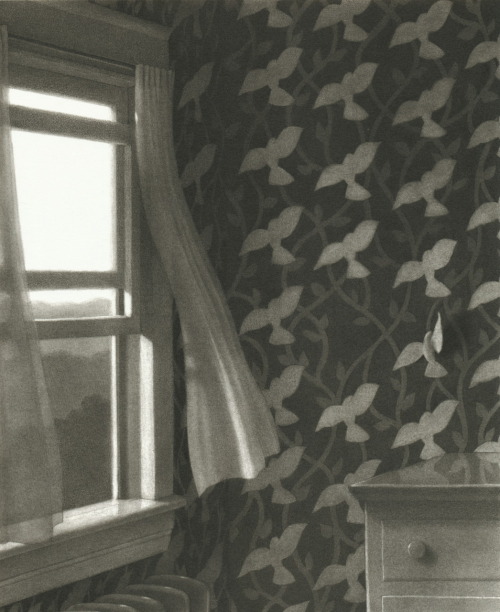
When I read or hear The Hedley Kow I am reminded of the book "Mysteries of Harris Burdick" by Christ Van Allsburg which gives us one page illustrated glimpses into this strange magical world (one of which is pictured to the right). These illustrations stir the imagination quickly, sort of introduce someone to this magical world, but leave everything open ended. I like it when fairy tales do this.

Further the Hedley Kow can be one of the funniest stories in the world, if it's told by the right person. However, if the story teller doesn't get the timing right than it will fall flat. In other words the Hedley Kow reminds us that fairy tales are best when they are told.

Growing up in America we seemed to tend to focus on the Grimm's Brothers, and they have good stories, but I've found that the best fairy tales seem to reside on the outskirts of Europe and Asia rather than in their hearts. in places like England. Places where the fairy and the stories about them were important for a long time.

Read "The Hedley Kow" and about other English Fairies.

Friday, November 16, 2012

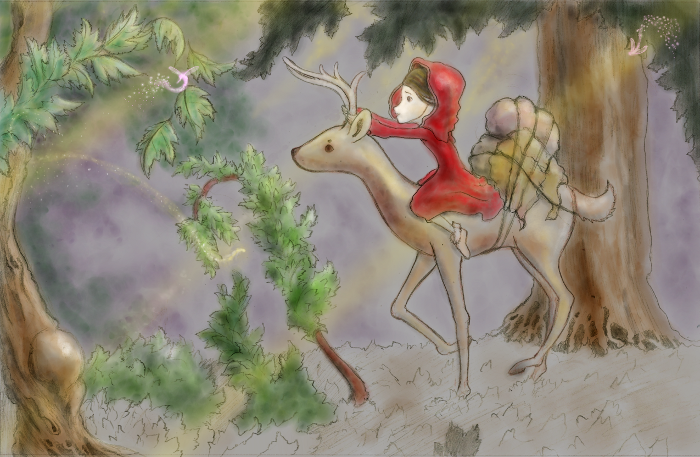
Little Red Riding Hood Riding Through the Fairy Forest

Of course Little Red Riding Hood rides into the still strangeness of the fairy forest... As a folklorist I'm always trying to understand what was happening in fairy tales, of course as an artist and writer I often make stuff up just to be weird. Though fyi, I like the version of Little Red Riding Hood better where she is a trickster figure who escapes from the wolf.

You can get a print of this work at

Thursday, November 15, 2012

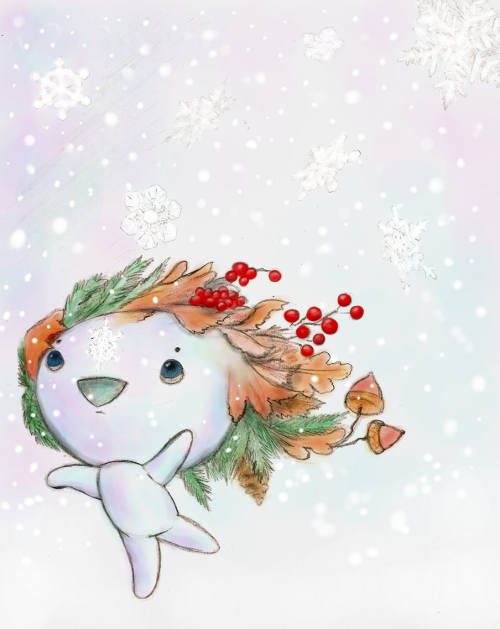
Pixie Wisp Eating Snow Flakes

http://zeluna.net/fairyart/pixiewispsnowflakes.html

Wednesday, November 14, 2012

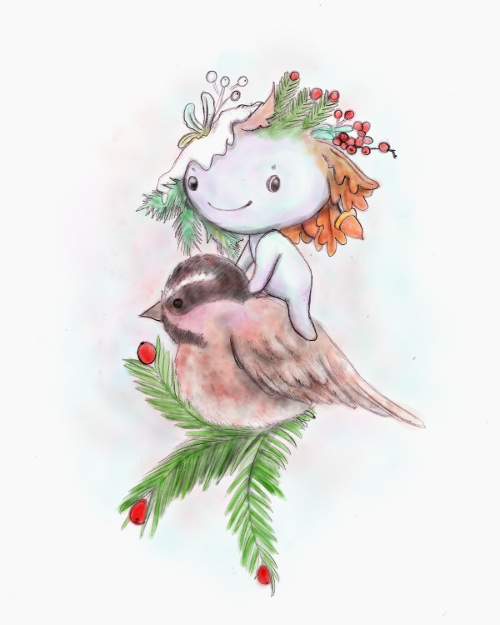
A Pixie Wisp Riding a Bird

Pixie Wisps are close companions with the animals, often living with them in their nests and burrows. Or riding the birds when they need to get somewhere fast.
http://zeluna.net/fairyart/pixiewisponbird.html

Tuesday, November 13, 2012

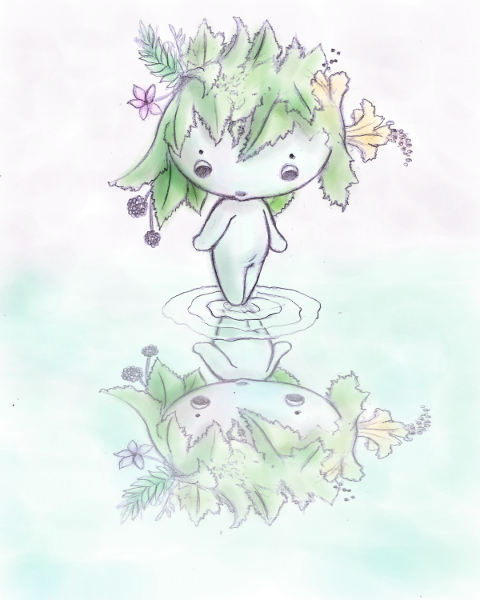
Pixie Wisp looking at its reflection

Monday, November 12, 2012

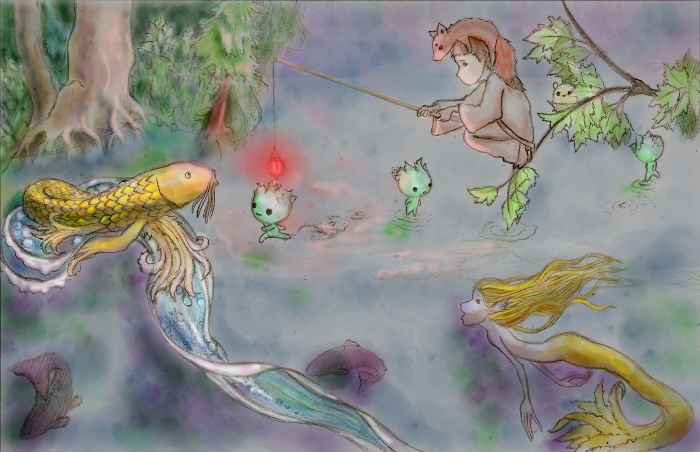
Fishing for the wishing fish


When his kingdom fell a young page was ordered to flee into the forest, into the realm of fairy. Where he now tries to find a way to save his kingdom. So now he fishes for the wishing fish, bobbing a small lantern to look like the dreams that the fish eats when the sun goes down.

Sunday, November 11, 2012

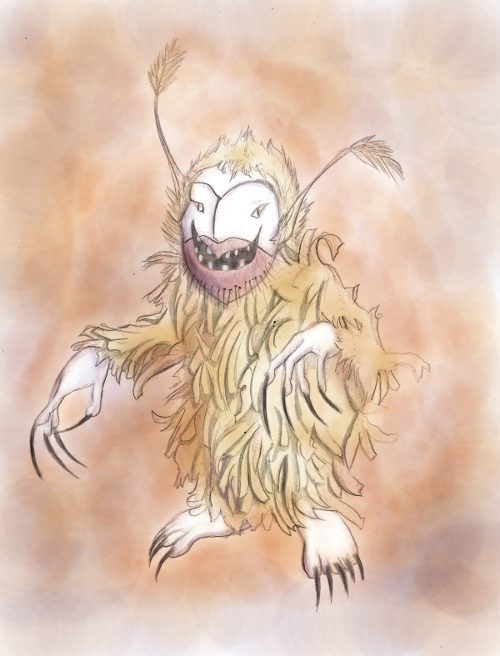
Bunnik

Bunnik are the guardian spirits of the Slavic bath houses. They protect people against illness, evil spirits and even vampires on occasion.
However as with all spirits they are duelistic, both creative and destructive for occasionally they'll flay peoples skin from their bodies with iron claws.

Saturday, November 10, 2012

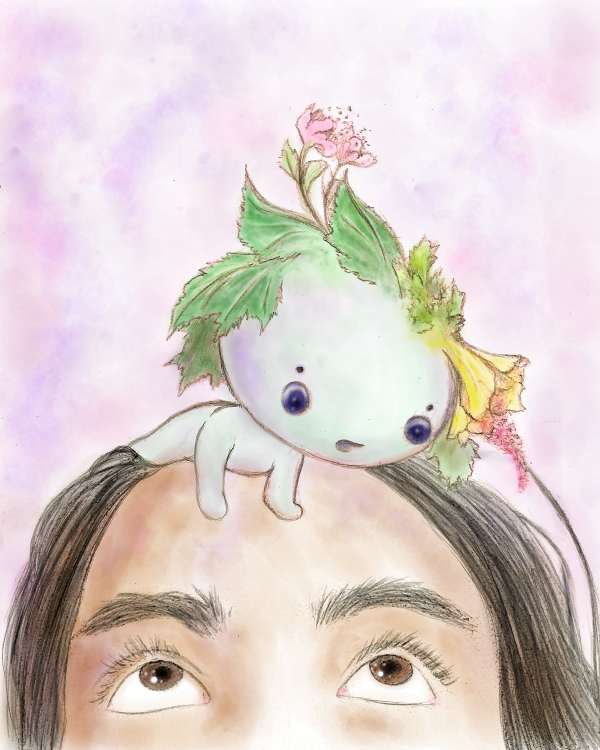
Humans do exist!!!

Hidden away in the forest for centuries a curious pixie wisp goes out to explore and discovers much to her surprise that humans do exist.

Saturday, August 18, 2012

Primal Fairies

I'm releasing my newest serialized story primal fairies at http://zeluna.net/stories/primal-fairies

Some of the art from this tale includes


18


Saturday, July 28, 2012

Forest Fairies (Pic 3)


Related Articles
Forest Fairies     Woodland Fairies      Fairy Stories      Sleeping Beauty Fairy       Fairy Story